A game and a reading
The Temple
A house of seven rooms, a list, and a knock at the door. The pictures are Johannes Gossner’s, from 1812, and older. The ending comes from Revelation 3.
The house of the heart
About ten minutes. Look around, pick things up and use them on things. Your list is by the front door.
Click or tap a thing to look at it or take it. Choose something you carry, then click where to use it. The Tab key moves between things. You carry a lamp. It goes where you point, tap or Tab. Where its light falls the house shows its colours, and what lives in it draws back.
Your progress is kept in this browser, so you can come back to it.
Ten pictures of one heart
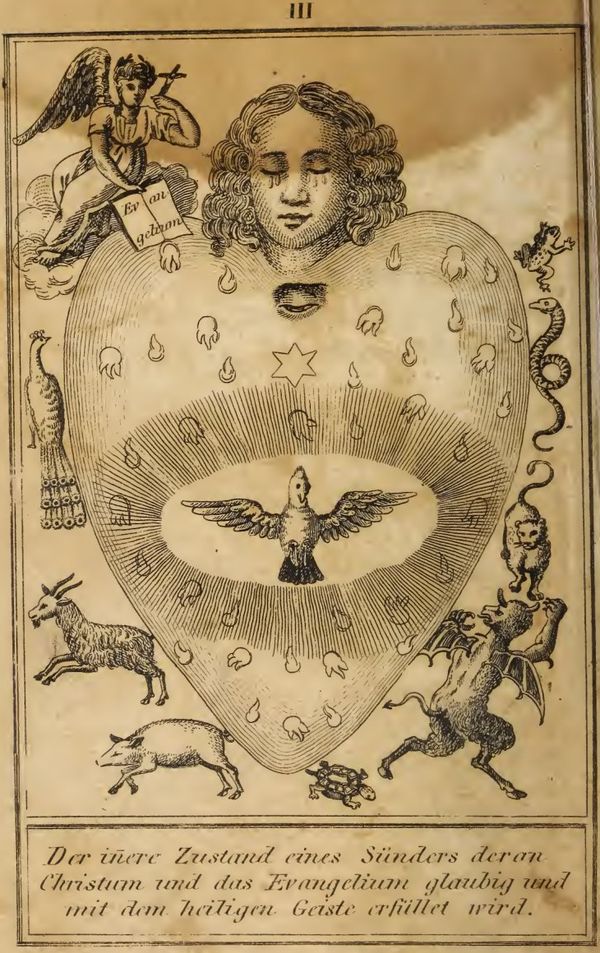
In 1812 Johannes Gossner (1773 to 1858) published Das Herz des Menschen, ein Tempel Gottes, oder eine Werkstätte des Satans: the heart of man, a temple of God or a workshop of Satan, in ten figures. Every figure is the same heart with a face above it. In the first, seven animals live inside, each one labelled in the engraving: the peacock for pride, the toad for greed, the goat for lust, the serpent for envy, the spotted cat for wrath, the swine for gluttony, the tortoise for sloth. A devil stands among them. Outside the heart wait an angel and a dove. The creatures in the game are cut from this plate.
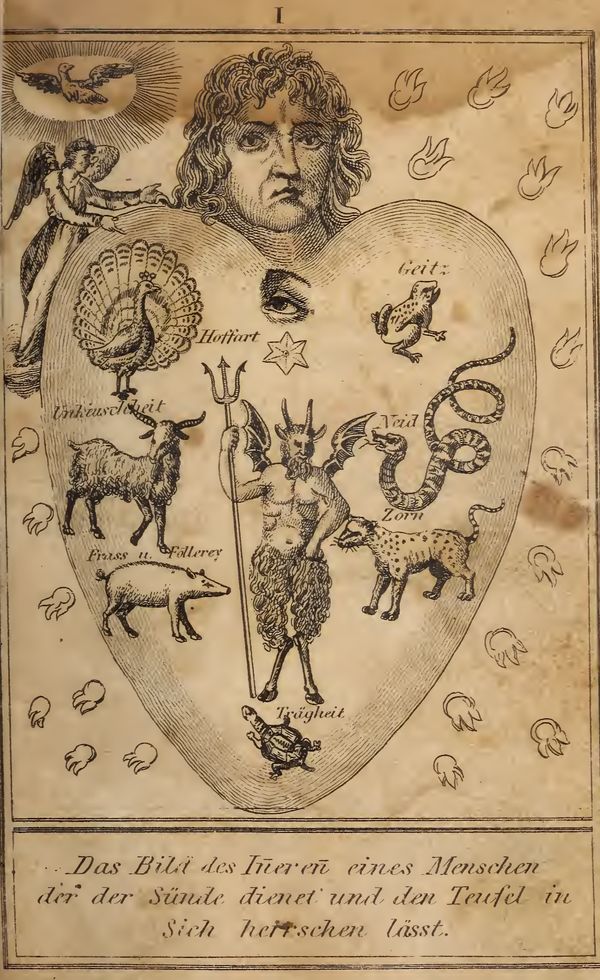
The book was not new even then. Gossner’s own note says the pictures were translated from the French and published at Würzburg in 1732. The Public Domain Review reports that Peter Daly dates that German version to 1733, and that David Morgan traces the whole picture tradition back to the Flemish engraver Anton Wierix and his series Cor Iesu amanti sacrum, the heart made holy to the one who loves Jesus.
Wierix engraved that series in Antwerp around 1600 (Morgan gives 1595; the National Gallery of Victoria dates its impression between 1590 and 1604). In one plate the Christ child stands inside the heart and sweeps it out with a broom. Snakes, lizards and a small dragon tumble from the bottom. The verse under the picture is Latin:
O beatam cordis aedem, te cui caelum dedit sedem purgat suis manibus. Animose puer verre, monstra tuo vultu terre, tere tuis pedibus.O blessed house of the heart: he to whom heaven gave its throne cleanses you with his own hands. Sweep boldly, child; frighten the monsters with your face; tread them under your feet. (Our translation.)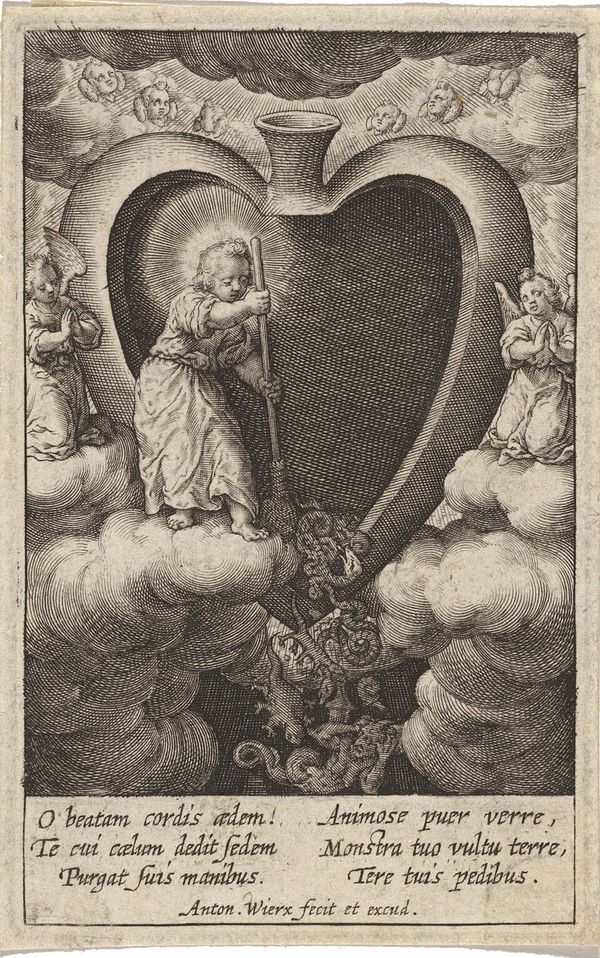
The house swept and empty
When an unclean spirit has gone out of a man, he passes through waterless places seeking rest, and doesn’t find it. Then he says, ‘I will return into my house from which I came;’ and when he has come back, he finds it empty, swept, and put in order. Then he goes and takes with himself seven other spirits more evil than he is, and they enter in and dwell there. The last state of that man becomes worse than the first. Even so will it be also to this evil generation.Matthew 12:43 to 45, World English Bible
Luke gives the same saying (Luke 11:24 to 26). Gossner quotes it from Luke when he comes to it (his printing gives the chapter as 9), and in his German the spirit finds the house “mit Besen gekehrt”, swept with brooms. His seventh figure is that saying drawn out: a heart that had once been cleared, now full again, every animal back and each one ridden by a demon, with a crowned figure enthroned in the middle. The caption calls it the state of a person who after conversion has fallen back into the old sins. The riders in the game come from that plate.
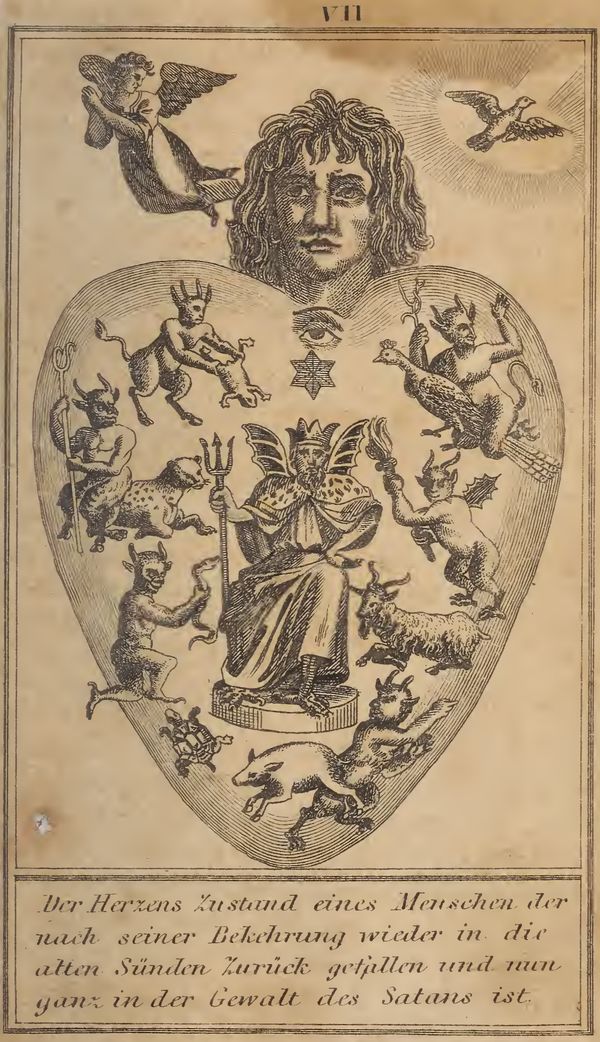
In Matthew the saying ends with “this evil generation”. It follows the dispute over whether Jesus casts out demons by Beelzebul (Matthew 12:22 to 32), and in that setting it is a warning about a people as much as about one person. Gossner reads it of the single heart. The game follows Gossner, and this page says so.
The knock at the door
Behold, I stand at the door and knock. If anyone hears my voice and opens the door, then I will come in to him and will dine with him, and he with me.Revelation 3:20, World English Bible
The knock in the game comes from the letter to the church at Laodicea (Revelation 3:14 to 22), the church that is neither cold nor hot. The one who knocks does not break the door down, and he does not wait for the house to be tidy. The words are addressed to a congregation; the game reads them of one person, as the old devotional pictures do.
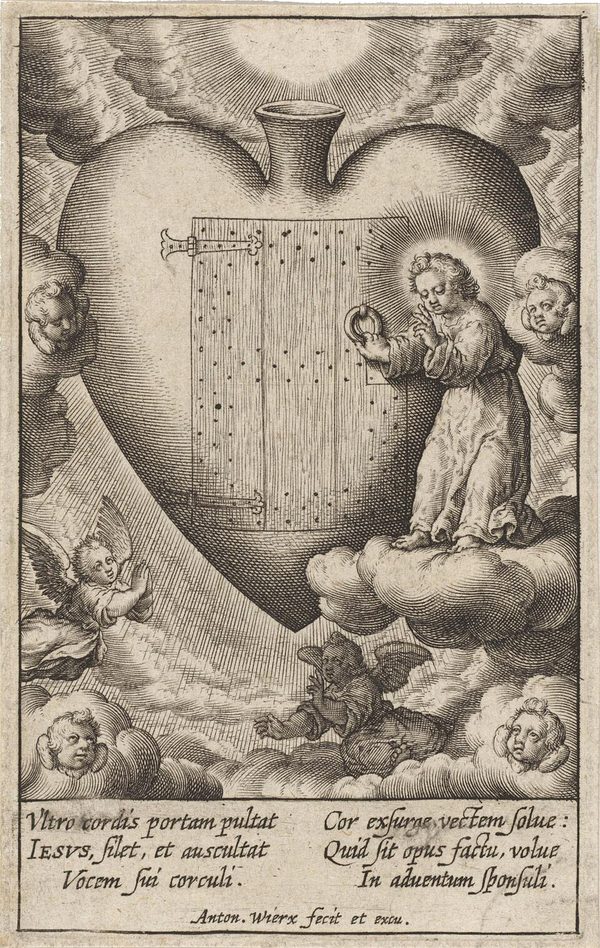
Wierix engraved that too, in the same series as the broom: the Christ child at a plank door in the heart, the knocker in one hand, the other raised to listen. The verse under the plate ends “Cor exsurge, vectem solve”: rise, heart, draw back the bolt. The bolt is on the inside.
Why every fix goes wrong
Every line on the list can be ticked, and every tick makes something worse. The tortoise leaves the sofa for the bed. The swine leaves the pantry for the dining room, and the pantry key ends up inside the toad. The letters burn, and Jakob’s apology burns with them. When the list is done the animals come home (Matthew 12:44), and the one scene where you take the broom to the whole house ends the way Matthew 12:45 says it does. The front door opens only when there is nothing left to put in order first.
That is on purpose. A game about keeping your heart clean by effort invites the objection a careful Christian reader raises first, and Lutherans have a word for it, Werkgerechtigkeit, righteousness by works. The pictures raise the objection themselves. In Wierix the broom is in the hands of Christ. In Gossner’s third figure the animals leave when the dove comes to live in the heart, not when the owner scrubs it.
Or don’t you know that your body is a temple of the Holy Spirit who is in you, whom you have from God? You are not your own, for you were bought with a price. Therefore glorify God in your body and in your spirit, which are God’s.1 Corinthians 6:19 to 20, World English Bible
Jesus answered him, “If a man loves me, he will keep my word. My Father will love him, and we will come to him and make our home with him.John 14:23, World English Bible
Paul’s picture is a temple with someone living in it, and John’s is a home. Neither is a house kept empty.
What this page does not claim
These are devotional pictures, not evidence for anything the rest of this site argues. The pairing of animals with sins is a convention of the emblem books; Scripture does not assign it. Even the authorship of the 1812 book is disputed: library records name Gossner, Gossner with Philipp Friedrich Pöschel, or Johannes Nikolaus Jürgens Schmidt. The game is a picture of one idea in about ten minutes, and it can be argued with.
Pictures and texts
- Das Herz des Menschen, ein Tempel Gottes, oder eine Werkstätte des SatansPrinted after the fifth Augsburg edition of 1815. Library of Congress copy, scanned by the Internet Archive, public domain on Wikimedia Commons. Figures I, III, V and VII, the game’s creatures and the dove are taken from this scan.
- Anton Wierix II, Cor Iesu amanti sacrum, the heart swept by the Christ childNational Gallery of Victoria, Melbourne. Public domain on Wikimedia Commons.
- Anton Wierix II, Cor Iesu amanti sacrum, Jesus knocks at the door of the heartNational Gallery of Victoria, Melbourne. Public domain on Wikimedia Commons.
- The Public Domain Review, The Heart of Man (1851)On the English edition, the Würzburg source and the Wierix tradition, citing Peter Daly and David Morgan.
- World English BiblePublic domain. Matthew 12:43 to 45, Revelation 3:20, 1 Corinthians 6:19 to 20, John 14:23.